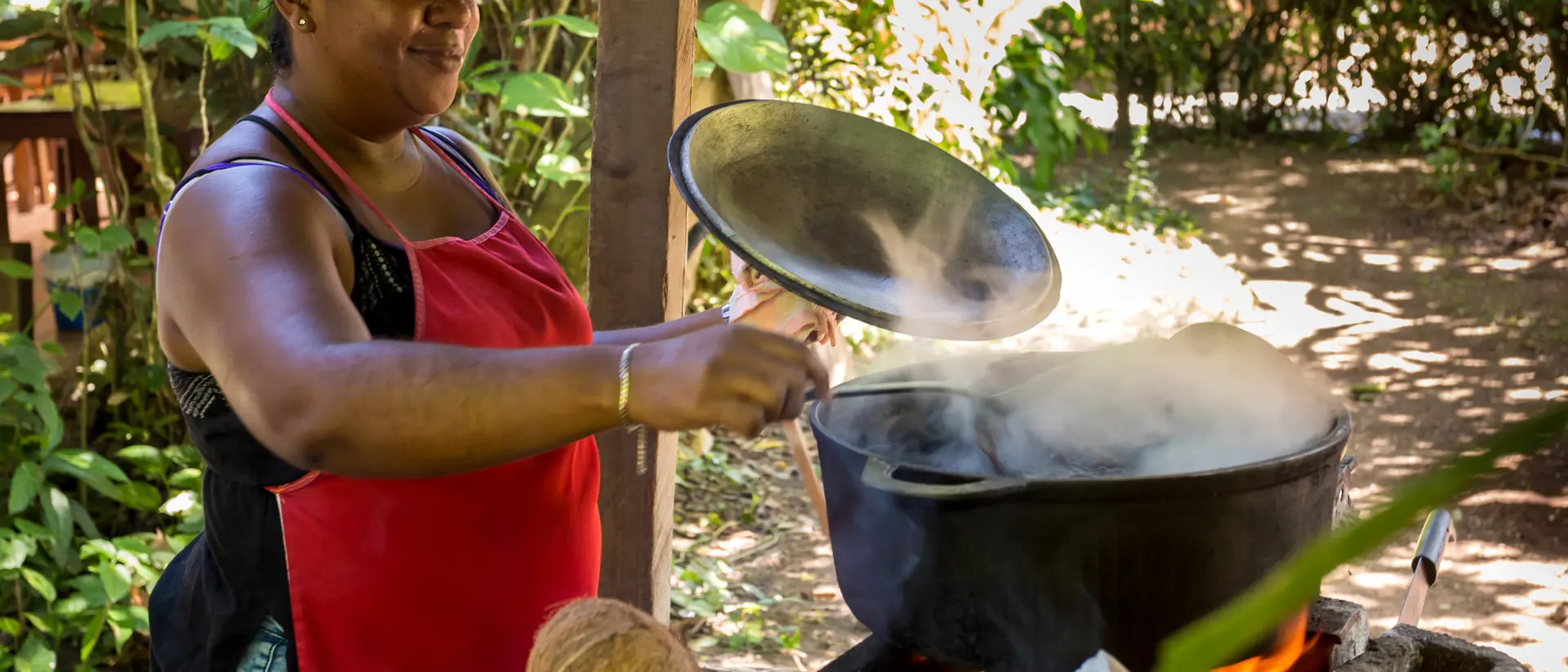



The national dish is gallo pinto, a flavourful mix of rice and black beans often served for breakfast with eggs, plantains, and tortillas.
Costa Rica Travel Information
Not sure which theme is right for you?
Food & Drink
Costa Rican cuisine is at the heart of the country’s culture: fresh, vibrant, and bursting with flavour. Meals are often simple but rich in local ingredients, from tropical fruits and freshly caught seafood to the country’s world-class coffee. Whether enjoying casual street ceviche, sipping a smoothie at a roadside stand, or indulging in fine dining in San José, food is an experience deeply tied to daily life.
“Gallo pinto—fried rice and black beans—is Costa Rica’s national dish, often served for breakfast,” says Destination Specialist Kajal Gadhia, who highlights how such fare connects travelers with the rhythm of Costa Rican mornings. Do not be put off thinking this is your only breakfast option - all Goway selected properties will offer a wide range of options to get your day started.
To indulge in your own Costa Rican food and drink odyssey, speak to one of our Destination Specialists today.
A Culinary Overview of Costa Rica
Costa Rican food celebrates fresh produce and simple flavours, anchored by staples such as rice, beans, and plantains.
Local herbs like cilantro, tropical fruits, and fresh seafood shape the cuisine, with popular dishes including ceviche, tamales, and casado, a hearty lunch plate composed of rice, beans, salad, plantains, and protein (casado means "married" in Spanish and refers to the harmonious blend of ingredients on the plate as well as the wives who traditionally prepared these meals for their worker husbands).
Regional variations add additional depth. The Pacific coast is renowned for its seafood, while the Caribbean side draws on Afro-Caribbean influences with bold jerk spices and coconut flavours. Inland, highland regions are celebrated for their coffee, considered among the finest in the world.
Unique Costa Rican Dining Experiences
Dining in Costa Rica is as much about setting as it is about taste. Enjoy beachfront sodas (family-run eateries) with ocean views, pause at fruit stands piled high with mangoes and pineapples, or relax in rainforest cafés while listening to birdsong.
San José food tours showcase local markets, artisanal chocolate, and evolving fine dining, while the Central Valley offers unforgettable coffee plantation visits where travelers can sample freshly roasted beans at the source.
For more on the national dining scene, explore our Costa Rica travel tips and etiquette guide.
Costa Rica’s Beverage Scene
Love coffee? The beverage is among Costa Rica’s biggest draws, with Arabica, Caturra, and Geisha beans cultivated in the fertile Central Valley. Plantation tours let travelers see the process from bean to cup, capped with tastings of some of the world’s finest brews.
For something stronger, visitors can sample rum tastings at local distilleries or try guaro, a sugarcane-based spirit often mixed into cocktails. Along the coasts and in boutique bars, craft beer is also gaining popularity, adding a modern twist to the country’s drinking culture.
Dining Etiquette in Costa Rica
Dining in Costa Rica is casual and warm, reflecting the country’s laid-back pura vida lifestyle. Meals are often family style and unhurried, with many locals eating dinner early in the evening. Restaurants range from humble sodas (family-run eateries) to upscale venues in San José and the beach towns.
Service is typically friendly and informal. Tipping is modest and usually included in the bill, though leaving a small additional gratuity for good service is appreciated. For deeper insight into customs, explore our guide to Costa Rican cultural traditions.
Accommodating Dietary Needs in Costa Rica
Costa Rican cuisine is naturally adaptable to a wide range of diets. With its emphasis on fresh produce, rice, beans, and tropical fruits, vegetarians and vegans will find plenty of satisfying choices. Dishes like gallo pinto, plantain-based sides, and hearty vegetable soups are easy staples.
Seafood lovers can indulge in the country’s coastal offerings, while meat eaters will find flavourful stews and grilled specialties. During Lent, many Costa Ricans opt for fish, seafood, or vegetarian plates, which makes this a particularly good time for travelers who prefer lighter or meat-free dining.
Most hotels, eco-lodges, and restaurants are accustomed to accommodating dietary requests, ensuring that travelers with restrictions or preferences can enjoy meals with ease. The focus on fresh, locally sourced ingredients means flexibility is built into the dining culture.
Plan Your Costa Rican Culinary Adventure
Costa Rica offers unforgettable food and drink experiences that go beyond traditional dining.
Imagine a private-chef dinner under the stars, where local flavours are paired with fine wines. Join farm-to-table tours that showcase fresh produce and sustainable practices or visit coffee estates in the Central Valley to taste some of the world’s best beans right at the source.
To book your own custom Costa Rica food and wine journey, contact Goway today.
Featured Costa Rica Trip Ideas
Costa Rica Travel PackagesHighlights of Costa Rica: Rainforest & Coast
Manuel Antonio National Park and ArenalThrill and chill on this Private-guided Costa Rica journey, with ziplining, whitewater rafting, and rainforest walks from Arenal’s peaks to Pacific shores.
8 days
From US$3,298/p.p.
Request a Quote
Highlights of Costa Rica: Rainforest & Coast
Manuel Antonio National Park and ArenalThrill and chill on this Private-guided Costa Rica journey, with ziplining, whitewater rafting, and rainforest walks from Arenal’s peaks to Pacific shores.
8 days
From US$3,298/p.p.
Request a Quote
Travel Stories
Get inspired about Your Trip to Costa Rica
A Costa Rica for All Seasons
It's the middle of March and the golden sands of Playa Grande, Costa Rica glisten as the sun races towards the horizon. A gentle Pacific Ocean breeze ...
Why Nicaragua Is Central America’s Next Great Discovery
Picture this: You are standing on a misty mountain ridge 1,500 metres above sea level, surrounded by emerald-green cloud forest and the call of wild b...
Bussing Down to Rio & Beyond: Goway Goes to Latin America
Like other globetrotter destinations such as Africa and Europe, Goway’s roots in Latin America began in the 1970s. I had started Goway by specializing...
Frequently Asked Questions
What is the national dish of Costa Rica?
What is the national drink of Costa Rica?
Costa Rica is known for café chorreado (traditional drip coffee) and guaro, a clear sugarcane liquor often mixed into cocktails.
What do locals eat in Costa Rica?
Locals enjoy casado (a plate with rice, beans, meat or fish, salad, and plantains), as well as fresh tropical fruit and seafood in coastal areas.
What time is dinner eaten in Costa Rica?
Dinner is usually eaten early, around 6:00 to 8:00 p.m.. Meals are often casual and family-oriented.
What fruit is Costa Rica known for?
Costa Rica is famous for its pineapples, bananas, mangoes, papayas, and guavas, all of which are grown locally and enjoyed fresh.
What are the dos and don’ts when it comes to eating in Costa Rica?
Dining is informal and friendly. It is polite to keep your hands visible (but don’t rest your elbows on the table) and tipping around 10 percent is customary in restaurants
Costa Rica Travel Information
Not sure which theme is right for you?
Unlock more by subscribing to our newsletter.
With our newsletter, you’ll get access to regular communications that inspire you and help you explore the world your way.Exclusive Savings
Insider Benefits
Trending Stories

ExcellentBased on 5,298 ReviewsThis was the first time we had utilized Goway. We wanted a custom itinerary for a 3 week Italy, Athens and Greek Island adventure. Edwina Brislane was receptive to our goals for the trip, had helpful suggestions and reacted well to our requested revisions. Lisa Dachuk helped "tie a ribbon" on the trip and ensured we had considered all aspects of the experience. Lisa dealt quickly with a couple of requests while on the trip and celebrated a successful trip with us.
We enjoyed working with both Edwina and Lisa. Their knowledge and enthusiasm contributed to our very memorable trip.Dan & GailI had a great experience booking Australia and New Zealand trip through Goway Travel. Lori Mezzoro was very helpful and organized. All the recommendations she made were very good. I had a great trip with my kids.LauraI recently traveled to Greece with friends, and our entire experience was exceptional thanks to the planning support we received from Avery at GoWay. Every part of our itinerary was organized with care, accuracy, and great attention to detail.
Our accommodations — Hera Hotel Athens and Sofitel Athens Airport — were comfortable, well‑located, and exactly what we needed. All airfares from Calgary and the multiple transfers (airport to city centre, city centre to Piraeus Port, and back again) were perfectly coordinated and made the trip completely stress‑free.
The 7‑night Idyllic Aegean Cruise was a major highlight. It was beautifully arranged and gave us an unforgettable way to explore the islands. Our excursions were equally impressive:
Skip‑the‑Line Acropolis & Acropolis Museum timed entry, which made sightseeing smooth and efficient
Classical Greece: Olympia, Delphi & Meteora, a breathtaking and well‑paced journey through some of Greece’s most iconic historical sites
Avery was consistently responsive, knowledgeable, and proactive throughout the planning process. Every confirmation, transfer, and timing detail was handled flawlessly, allowing us to simply enjoy the trip without worrying about logistics.
I highly recommend GoWay Travel — and especially Avery — for anyone planning a trip to Greece. This was one of the best travel experiences I’ve had, thanks to their outstanding service and organization.LorraineMy husband and I just returned from a wonderful 2 week trip to Chile, South America arranged for us by Goway Travel. Every detail of the trip was outstanding. The hotel choices were perfect for us as were the tours Goway arranged. All the guides were prompt, friendly and very knowledgeable. Our Destination Specialist, Karen Larrota, did an fantastic job setting up the itinerary. Communication with her during the booking process was excellent. The Goway customer service team reached out to us several times during the trip (as did Karen) which was very reassuring.
We have traveled with Goway previously and will surely do so again. Regina ChaplesAn Extraordinary Tour Guide in Xi’an China Leo a blessing we will never forget
There are some people who come into your life and leave footprints on your heart that will last forever, Leo was one of those people for us.
My husband, Keith, and I dreamed of visiting China for more than 30 years and Leo helped make that dream an unforgettable blessing. He was more than a tour guide. He was a wonderful teacher, a caring soul, and a blessing from God.
His knowledge of Chinese history and culture was remarkable from the terra-cotta warriors to the ANCIENT city wall, the Monastery, and the local art gallery, Leo brought every experience to life. He taught us so much and helped us appreciate the beauty and history of China in ways we will never forget.
What touched me most was his compassion for my husband Keith, knowing Keith had difficult breathing and walking long distance and walking Leo thoughtfully arranged a wheelchair so he could enjoy the journey with everyone that kindness meant more to me than words can express
Leo patience, professionalism kindness and genuine care for our group. May every moment special. He make sure we were comfortable learned something new and enjoyed authentic Chinese food and created memories we will cherish for a lifetime
I truly believe God placed special people in our lives for a reason, and Leo was certainly one of those blessings for our group. We are forever grateful for the knowledge, laughter, compassion, and beautiful memorial. He gave us
I recommend Leo wholeheartedly, to anyone visiting Xi’an China. You will leave with more than photograph you will leave, with knowledge appreciation, and memories that stay in your heart forever
Leo may God continue to bless you, protect you, and guide you as you touch the lives of travelers from around the world. Thank you for being such a beautiful part of our China story. You will never be forgotten
With love and gratitude
Lisa & KeithLisa PaulMy wife and I have just returned from our 5th trip with Goway. Once again everything ran smoothly from first day to last. This trip was the 9 day all Ireland tour which covered both north & south Ireland. The tour was operated by Rabbies tours whom we used in Scotland and the 16 passenger van only had 6 passengers including us.Other than a couple of days the weather was prety good although the wind did get a bit wild. The pub food was delicious & i got a taste for real Guiness. We spent a few extra days in Dublin and found it very expensive, the excange rate didn't help. Our travel consultant Jaqueline personalised the trip and was very helpful. George CroomeWe were able to see the perfect amount of sites during our nearly 3 weeks in Australia. Sam Day was extremely knowledgable about every step of the travel process. He was incredibly patient with all the demand my wife and me had. We really look forward to using his services again.Alan RosenbergMy husband and I booked a tour to Portugal using Goway travel. Working with Phoebe was a pleasure. She responded promptly and professionally to all of my requests, concerns and queries. Our trip was filled with lovely details and unexpected treasures.Kristen RemsenMy trip to China was a wonderful experience, and everything was planned very well. The itinerary was well organized by Ms. Harpreet Litt. The arrangements were smooth, and the overall trip was enjoyable.
I appreciated the attention to detail and the excellent coordination throughout the journey. It was a memorable experience, and I would highly recommend this trip to anyone planning to visit China!edytaHarpreet Litt provided us with a rich experience for our week. She offered good choices for local tour companies. We had a very good guide in Osaka. She is an Osaka resident with good English skills. She took extra pains to include opportunities we requested Osaka was a beautiful city at night. My photos of restaurants and street food were colorful and fun. Food was good too.Noel Chrisman
Verified
Verified
Verified
Verified
Verified
Verified
Verified
Verified
Verified
Verified