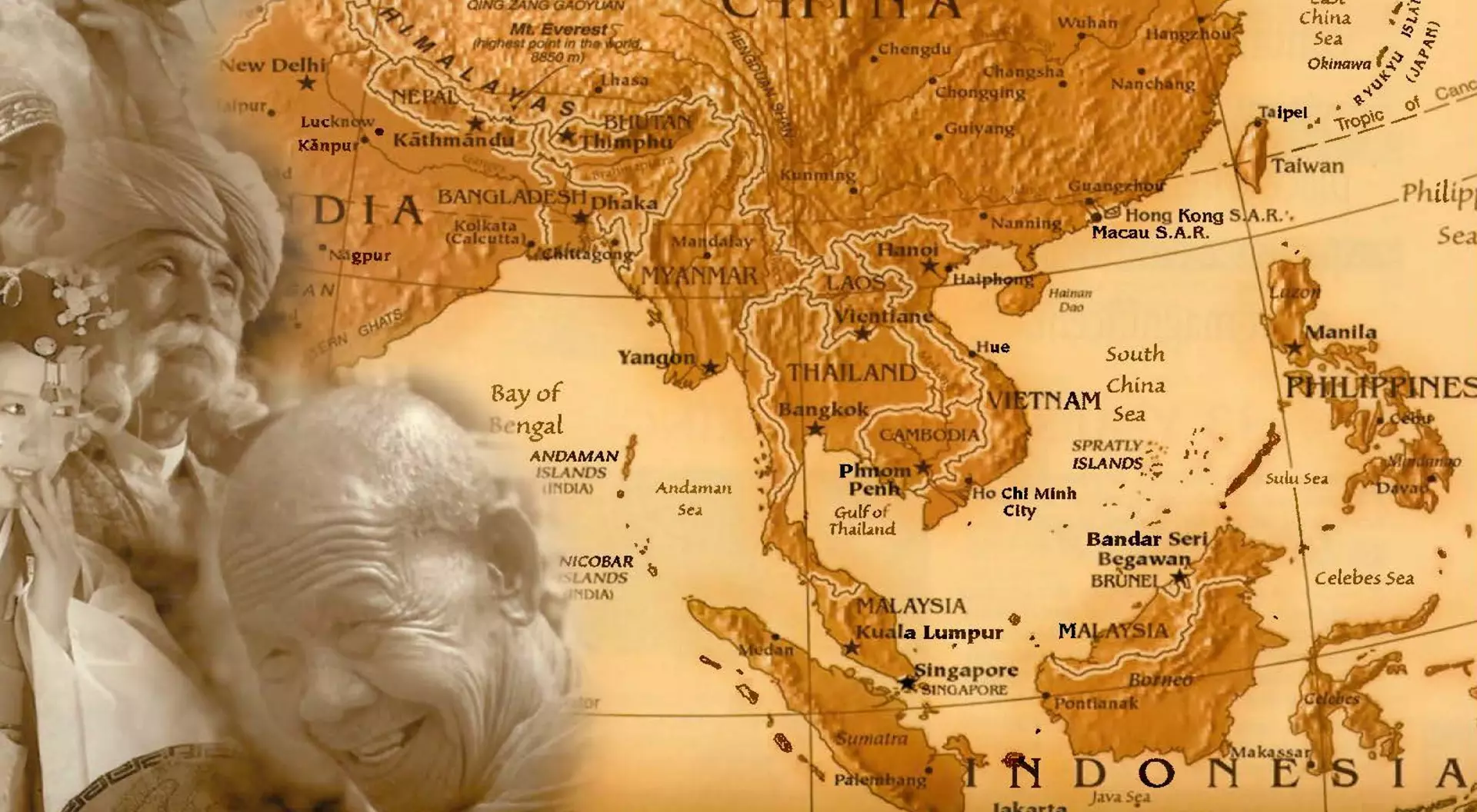


When Goway was born in 1970, selling a large range of travel ideas to Asia was not in my thinking at all. In fact, I don’t know who else in North America might have been a pioneer in the 1970s for travel to the continent. It had only been 25 years since atomic bombs had been dropped on Japan to end the Second World War. Then there was the Korean War from 1950 to 1953, which officially never ended. And when I was trying to get Goway off the ground, the Vietnam War was raging.
Many Asian countries at the time were pushing for and/or experimenting with independence from their colonial rulers. Think Malaysia and Burma (from Britain), Vietnam (France), and Indonesia (the Netherlands). Although China and Korea had been freed from Japanese occupation after World War II, China under Mao’s Communist rule was an economic basket case for a long time. I remember contributing to Chinese charities back in Australia.
During the late 1970s and 1980s, the Asian economic miracle occurred, with many East and Southeast Asian economies, including Japan, South Korea, Singapore, and later China, experiencing rapid economic growth, which in turn created a new middle class with disposable income.
The late 20th and early 21st centuries saw a massive increase in global tourism driven by continued globalization and falling airfares. For its part, Asia would become one of the most popular tourist destinations in the world.
But Back to Goway’s Origins
In the late 1960s, there was a travelling wave of young adults—baby boomers from Australia, New Zealand, and South Africa, as well as Canada and the USA. We were an affluent and very fortunate generation compared to our parents, who had lived through the Great Depression and the Second World War.
Growing up, we were taught about the British Empire and the “sun never setting” on it. It was also the Swinging Sixties, when a youth-driven cultural revolution, centered in London, broke out, characterized by a new sense of freedom in music, fashion, and social attitudes. The era marked a break from the past with a focus on modernity, fun, and experimentation. Music was a central force, with bands like the Beatles and Rolling Stones leading the “British Invasion” of the world, shaping the new youth culture.
From a travel point of view, young Australians and New Zealanders were at the head of the pack. Living on the other side of the Earth, they took extended leave trips to London and Europe, longer in duration than those of other nationalities. I, for instance, was given a year’s leave of absence from my job at the Reserve Bank of Australia and never officially returned.
Most Aussies and Kiwis did eventually return; Qantas had a special Under 26 Pacesetter Fare to London and Overland Adventure Journeys between London and Kathmandu were developed. These were the first trips to Asia that a fledgling Goway Travel sold and promoted. While London was the centre of the British Invasion for baby boomers, Kathmandu was the world mecca for hippies. These Overland Adventure Journeys operated in either expedition trucks or coaches using a combination of camping and budget hotel accommodations along the way.
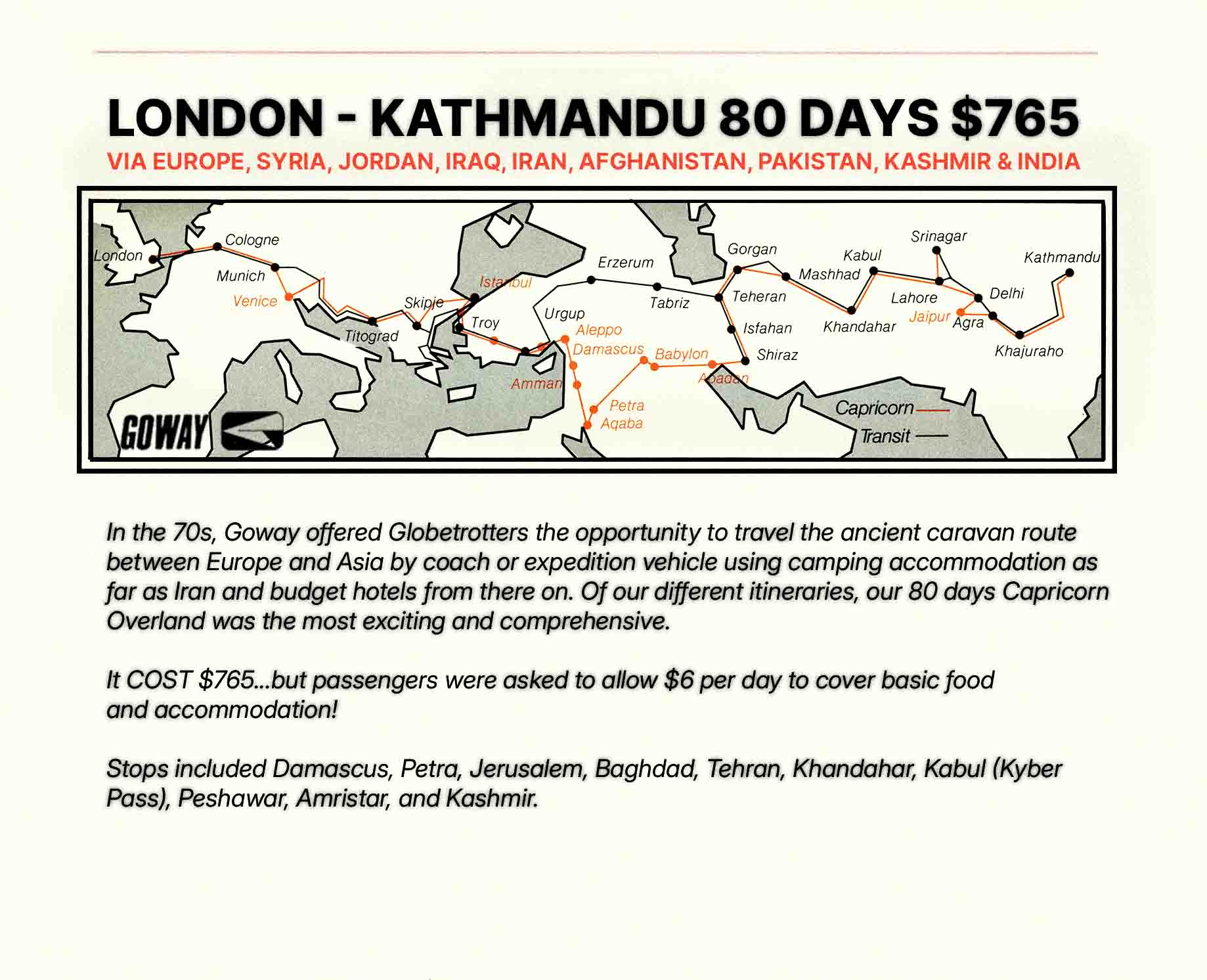
Itineraries ranged between 50 and 80 days depending on what route was taken. The 50-day journey took nine days to get to Istanbul and then continued through Turkey, Iran, Afghanistan, West Pakistan, Kashmir, and India to Nepal. The 80-day itinerary continued from Istanbul via Gallipoli (for Aussies and Kiwis) to Syria, Jordan, Israel, Iraq, Iran, Afghanistan, West Pakistan, India, and Kashmir to Nepal. One departure was scheduled for Christmas in the Holy Land.
Today it is hard to believe it was safe enough to undertake these itineraries. To avoid hassles at Arab border crossings, travellers identifying as Jewish were issued fake baptismal certificates. From Kathmandu, passengers would fly on to Australia and New Zealand, mostly via Bangkok, Thailand.
As vehicles had to return to London, reverse overland itineraries were available for young New Zealanders and Australians heading in the opposite direction to swinging London and Europe.
Asian Adventures Ensue
Among these overland clients of Goway’s were two Canadian women in their early 20s. They had flown to London and checked in for their trip three days before it started, but they ultimately missed their departure. As a result, I got a call to try and track them down through their travel agent and ultimately their families. Their whereabouts became so concerning that Interpol became involved. After two weeks, the women turned up at the campsite in Istanbul. As they had already been to Europe, they decided to find their own way to Turkey but didn’t tell anyone. On this ultimate of overland journeys these women had the trip of their lives. One of them was a multiple repeat client with Goway over the next 30 years.
Throughout the 1980s we promoted Goway as an Adventure Travel Specialist. We had produced Goway’s World Wide Young Adult Adventures brochure, which included camping tours in Europe, Australia, New Zealand, Canada, and the USA, as well as overland adventures across Asia and Africa plus Central and South America. However, it was our DOWNUNDER brochure with the upside-down logo that, for several editions, featured the “Qantas Koala” sporting hiking boots, a sleeping bag, and a walking stick, that captured travel agents’ attention.
But we were selling more than adventure. We were also offering South Pacific island stopovers, Australia and New Zealand coach-hotel tours, self-drive and motorhome itineraries, and much more.
In the process, we were given “special” airfares from Qantas and Air New Zealand. Without realizing it, we also got the attention of Asian carriers such as Cathay Pacific, Singapore Airlines, Malaysia Airlines, and even Garuda from Indonesia. This encouraged us to develop stopovers to Australia via Hong Kong, Singapore, Kuala Lumpur, and Bali. Very popular was a free return stopover to Bangkok from Hong Kong with Cathy Pacific. Over time we lost our adventure image but became the go-to travel company for the “Lands Downunder.” This led to the opportunity to also become a “go to” travel company for Asia, which of course didn’t happen overnight, but did over time. Over the years, I was aways looking for reliable quality local representatives in the destinations we would become specialists for.
Our offerings started with Asia stopovers to Downunder, then Circle Pacific, Orient Asia only, and also Around the World.
The clients we were really looking for were globetrotters. In all of our brochures (and on our website), we would state: "We want you to be more than satisfied with Goway’s services so that you will recommend us to your friends and next time you go travelling you will choose another great Goway Travel idea."
In the early days as an adventure operator, I would attend the annual FIYTO (Federation of International Youth Travel Organizations) conference. My good friend Rod Hurd from Travel CUTS (Canadian University Travel Service), one of the largest student travel organizations in the world, would also be in attendance at the FIYTO conference. A memorable one was in Beijing. A lot of Asian tour operators, hotels, airlines, and tourism boards would also attend PATA (Pacific Asia Travel Association) conferences around the Pacific.
Personally, it has never been my objective to see as many countries as possible. When I was a tour guide, I used to jokingly urge my passengers to “make sure you get another stamp in your passport so you can prove that you have done a lot of travel and obviously are interesting to talk to.” The travel sights are aways wonderful to see, but meeting the local people and having a local experience is what I think travel is all about.
Following are some examples of the experiences I had in Asia over the years.
Unique Hong Kong
The so-called Pearl of the Orient is an interesting destination. Over the years, Hong Kong became a sophisticated world-class city and business centre, although I loved the old era when it was a “seedy” British colony next to Communist China. In those days, it seemed open for all kinds of business and was great for shopping. Flying through the skyscraper buildings to land at the old Kai Tak Airport was always exhilarating. And as an ex-rugby player, I once enjoyed the city’s famous “Rugby Sevens” tournament.
Surprising Singapore
While it was never really seedy, Singapore can verge a bit on the sterile side, but it is definitely worth visiting. An affluent and prosperous city state, it is more than anything a story of “people power.” Although it was always on a trading route, it had no natural resources except its people (mostly Chinese) when it became independent from Britain and then Malaysia. On their own, Singaporeans developed a free-market economy and strong international trading links, achieving the highest per-capita gross domestic product in Asia.
As an Australian, I particularly enjoyed visiting the underground bunker where British and Australian generals met to plan for the famous surrender to the Japanese during World War II.
India: A Change Experience
For a long time, I used to ask myself: “If I only have one more trip to do, and it must be to a country I have already been to, where would I go?” My answer was always India. I have been to India six times and seen all the famous sites except a tiger. My son Adam, however, saw six on one of his trips. But it is not just the sights. It is the people, the hustle and bustle, the poverty and opulence. It is the colours and the noise, and it is the spiritual peace in places like Varanasi.
India, like some other countries in Asia, is an experience in itself.

India was where I did my favourite dad-and-daughter trip. However, I remember feeling very unwelcome at the Qantas business class check-in in Sydney, where I suspect the attendant must have thought Bronwyn Hodge was my trophy wife. We were going to a special “coming of age” religious ceremony and party for our Indian operator, who belonged to the Zoroastrian religion. It is one of the oldest faiths in the world and originated in ancient Persia (now Iran). It is not very large as one can only be born into it.
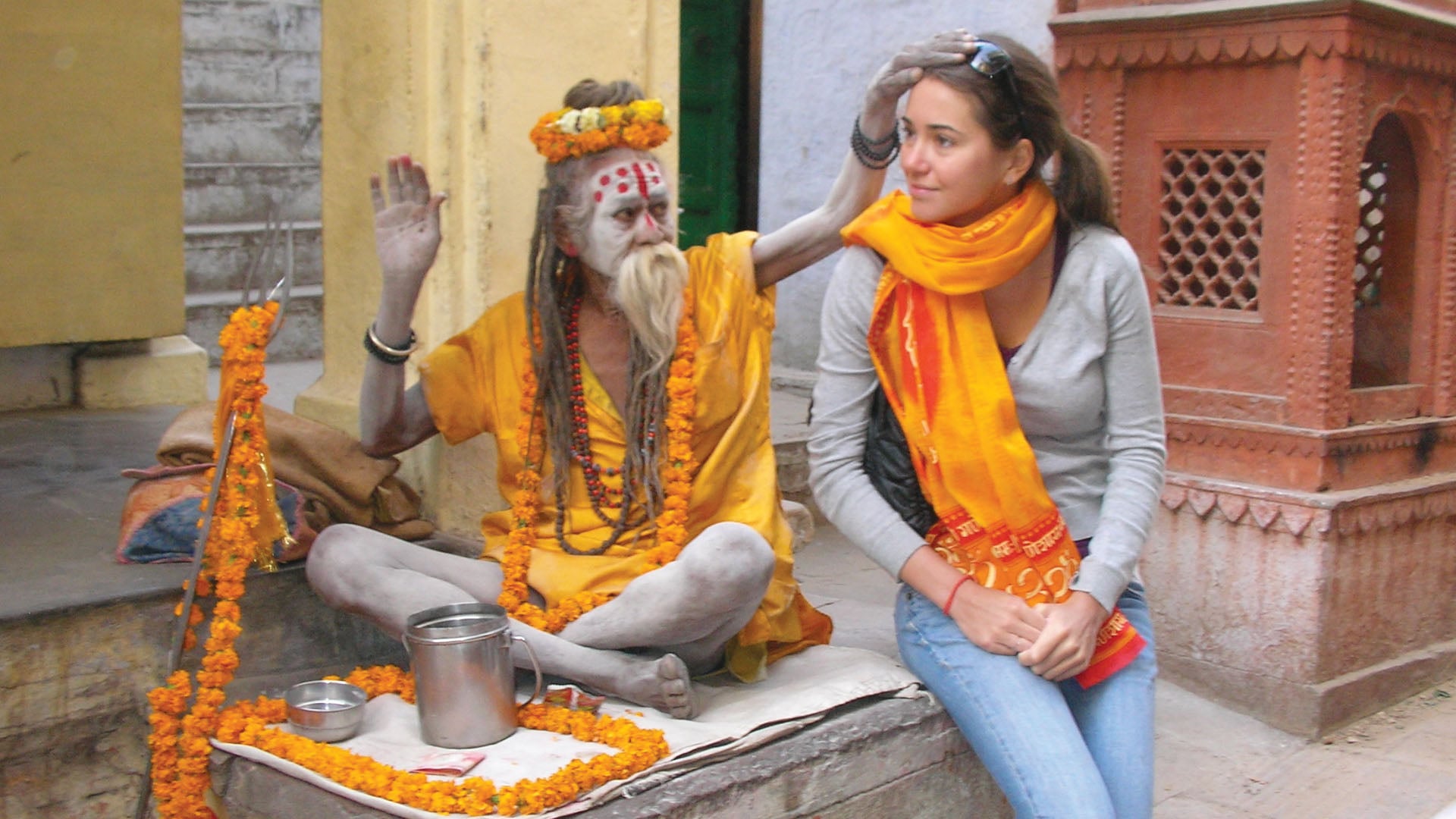
One of my favourite photos of my daughter shows her getting a blessing from a holy man in Varanasi. It is the spiritual capital of India and draws Hindu pilgrims to bathe in the waters of the Ganges River and perform funeral rituals.
On another trip with Claire, my wife, we were travelling with a small special group of USTOA (United States Tour Operators) and stayed in palace hotels (there are many in India). When we arrived in Jaipur, we were greeted by a crowd of people and a parade of vintage cars, horses, camels, and elephants. People threw flower petals from balconies and windows. That night we played elephant polo at an exclusive reception. I also enjoyed a morning balloon ride over the local mountaintop fort. We definitely felt like maharajas and maharanis.
Claire and I also experienced a free meal at the Golden Temple in Amritsar, one of Sikhism’s holiest sites, before taking in the very interesting Indian and Pakistan Border Guard Ceremony. We also experienced the beautiful beaches of Goa and stayed on a private houseboat in the lush backwaters of Kerala. Every time I visited the Taj Mahal, it was more impressive than the last. But it is Varanasi that always blows me away the most. It is seeing how happy the poorest of the poor are in their Holy City by the Ganges.
Amazing China & Tibet
Having visited China five times, I have seen it rise from an economic backwater to one of the globe’s leading financial and commercial powers. As an economist, it is a very impressive story that I have seen with my own eyes. On my first trip I remember walking around the market in Xi’an on my own. I was the only Caucasian and taller than everyone. Everyone seemed to ignore me but were very polite when I needed something. In India, I would have been swarmed by people. In Xi’an, I also bought a life-sized terracotta warrior that stands in the reception area of Goway’s Headquarters. I also experienced a Chinese massage in which the masseuse, with the help of handles on the ceiling, walked all over my back!
In China I saw the main sights (the Great Wall, the Forbidden City, Tiananmen Square full of bicycles, beautiful Guilin, impressive Shanghai, and more). But it was the energy I saw and felt on one particular trip that remains most memorable. This was a family reunion where we all met in Beijing. Adam had been backpacking around the Orient for many months, living on street food, and Bronwyn had been touring Europe for a few months. Adam’s first words were: “Dad, this hotel has a very nice steak restaurant.” Adam’s local experience was very useful when, four nights later, we boarded the Beijing–Lhasa Express for the 48-hour journey through the countryside and over the mountains and permafrost to Tibet. It is the highest railway in the world—so high that carriages are pressurized, with a meter telling passengers their altitude. Following Adam’s advice, we were self-catering. He also helped us interact with the locals on board, one of the main reasons I love travelling on trains.
All of us were impressed by the construction of all the buildings and roads and bridges we passed and the frequency of trains passing us from the other direction. Lhasa was more modern than we had imagined: most vehicles there seemed new. The Potala Palace, the former home of the Dalai Lama, is awesome. We were impressed by the affluent Chinese tourists in their designer clothes, and actually saw some being reprimanded by soldiers for taking photographs. Our Tibet guide then drove us on the brand-new Friendship Highway to the Nepalese border, with a side trip to the Chinese/Tibetan Everest Base Camp. While China was modernizing, we did notice in Tibet that farming was more basic, with yak-drawn hoes. We also trekked to a number of monasteries, including the world’s highest.
Then we spent a few days of bedlam in Nepal. Claire and I returned home via Qatar while Adam and Bronwyn went trekking together. At one point Bronwyn thought that she saw the last of Adam as he slipped over an edge somewhere. Apparently, he was saved by his backpack getting caught in bushes.
Nepal Trekking and Safari
Adam and I had also previously visited Nepal on a dad-and-son trip. It was the wet season, so we had to deal with leeches while trekking. We very much enjoyed engaging with Nepalese families, staying in their homes. Most people have heard of the Gurkhas, the soldiers famous for their bravery, loyalty, and discipline (and distinctive Kukri knives), and of course the Sherpas, the ethnic group that are famous for their mountaineering skills. Adam and I also visited Chitwan National Park, famous for the one-horned rhinoceroses, the Royal Bengal tigers, and the Ghani crocodiles. We did an elephant-back safari into the jungle and were told that, “if you were here last week, you would have seen a tiger.” Another Nepalese memory is travelling for a while on the main Mountain Road to India. It was more dangerous than any of the roads I ever experienced in South America.
Exotic Myanmar
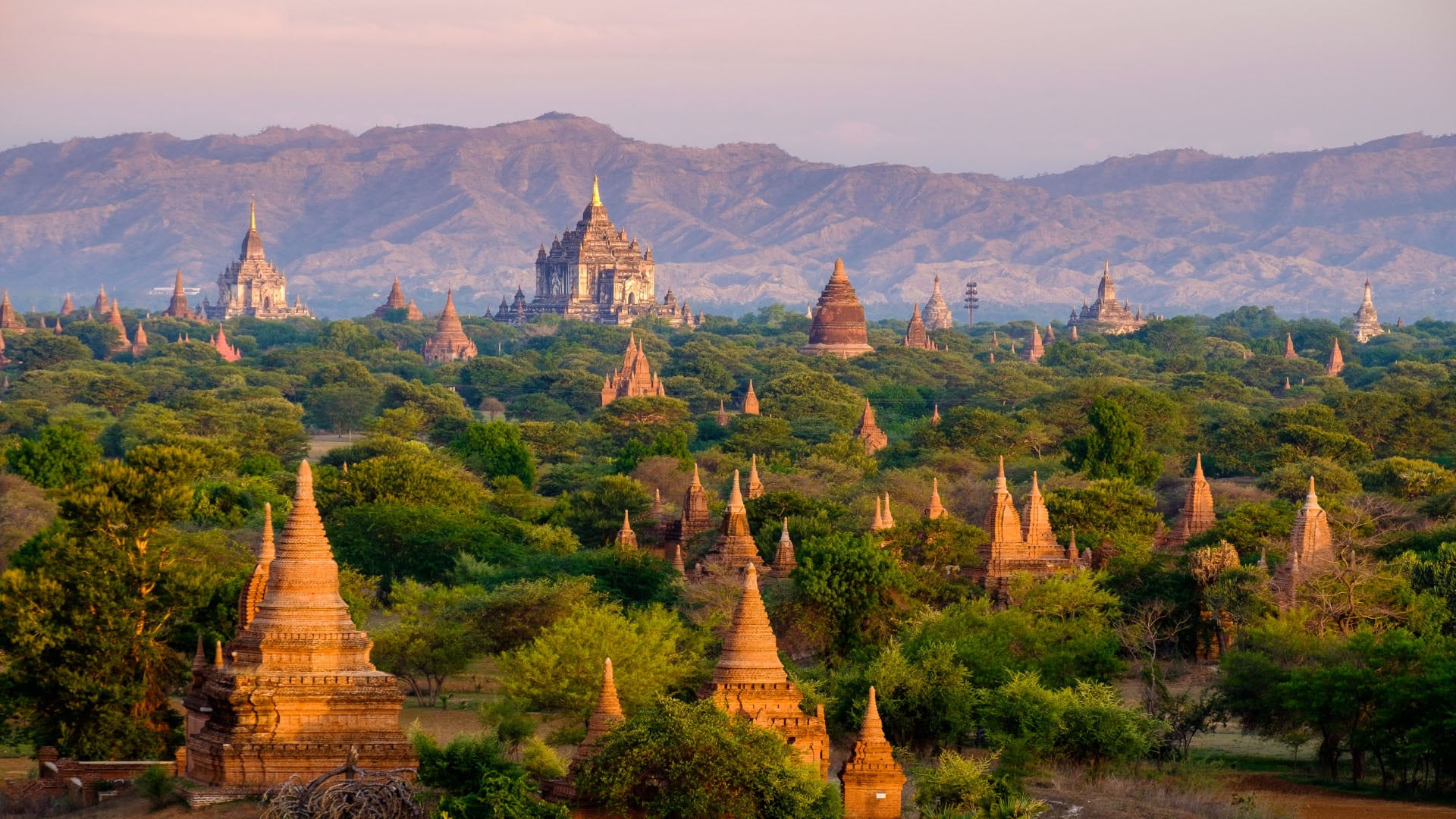
Growing up, I knew this country as Burma. And for most of my life, it has been closed or forbidden to visitors. For a time, when it did open, the Hodge family had a wonderful experience in this truly exotic country. The standouts for me were visiting the graves of Aussie soldiers from World War II and visiting the 2,500-odd remains of ancient Bagan at sunset. It was hard to visualize that once there were over 10,000 Buddhist temples, pagodas, and monasteries there. We were supposed to glide over the sight in a balloon that was fully inflated, but this was cancelled at the last minute. We did get souvenir baseball caps.
Visiting local villages on a riverboat experience, we came across the former home of George Orwell, the author of the book 1984. At one point, our fancy boat got stuck on a sandbank in the middle of the Irrawaddy River for several hours. We were eventually rescued by the locals in a plain old ferry boat. But the best experience was when, one night, we were swarmed, in Biblical plague fashion, by locusts. Bronwyn and Claire freaked out, but both Adam and I thought: “This is amazing!”
Other Asian Experiences
In Thailand, I met the Kayan women famous for their brass neck rings and visited Hellfire Pass and the Death Railway Museum & Floating Hotel. The father of Goway’s CFO, Peter Lacy, had survived working on the Death Railway; the Museum’s curator showed me his name in the camp registry. On my very first visit to Thailand, I was especially impressed by the beauty of the Thai ladies in national dress in a festival parade. Thailand also has stunning islands and beautiful hotels.
In Cambodia, meanwhile, stops included the Angkor Wat temple complex and the Killing Fields Phnom Penh Genocide Museum. While in Vietnam I drove around Ho Chi Minh City on the back of a motorbike, visited beautiful Halong Bay, and saw the Cu Chi Tunnels of the Vietcong, among other sights.
As mentioned earlier, the development of Goway as a go-to travel company for Asia started with our need to offer Asian stopovers on the way to Australia. We started building a whole separate division, through which we would brand Goway’s ASIA EXPERTS so they wouldn’t be confused with Goway’s upside-down DOWNUNDER EXPERTS. This Asian team had to provide the same top-quality product and service the Downunder team offered. Most of our South Pacific competitors said they sold Asia too, but enquiries were attended to by a South Pacific specialist doubling as an Asian expert. We had to be better than that, and over time we were.
Our last Asia brochure before the Covid-19 pandemic consisted of 68 pages featuring 230 Independent and Escorted Travel ideas. At time of writing, we offer on Goway.com 140 travel ideas with 32 advisors and support staff. Moira Smith, whom I have described elsewhere as the “Empress of Africa,” now runs our very established Asian team. She is supported by Brittany Banks, Asia Commercial Manager, who supervises and monitors all of Goway’s Asia product.
For a couple of years, we included an eight-page Orient & China insert in our popular Downunder brochure. In 1989, we decided to print a new Orient & China Escorted Tour brochure. Unfortunately, it was on the printing press when the Tiananmen Square revolt broke out, with the next full-colour brochure for Asia appearing three years later.
More Goway Origin Stories
"Asia Express: How Goway Ventured into Exotic" is the second in our series of origin stories about Bruce Hodge and Goway's over 55 years of globetrotting adventures. Visit Tales from the Road to see all the latest stories as they're published once a month this year.
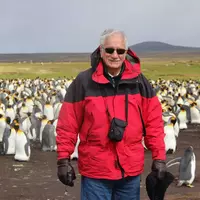
Bruce Hodge is the Founder & President of Goway Travel. In 1970, he started the company out of his Toronto apartment with nothing but a telephone and a projector. Over 55 years later, Goway has more than 800 team members across three continents who work tirelessly to craft dream vacations for globetrotters. Born and raised in Australia but making his home in Canada, Bruce always had a passion for travel and followed this dream to build one of North America’s leading travel companies.
While his bucket list only gets longer year after year, he continues to explore far and wide across Goway’s slate of over 115 countries on all seven continents. He has run the Athens marathon, climbed Mt. Kilimanjaro, ventured along the historic Canning Stock Route in Western Australia, trekked to penguin colonies in the Falkland Islands, and bushwhacked through the jungles of Papua New Guinea. He’s continually drawn beyond the horizon to experience all the riches that our wonderful world has to offer.